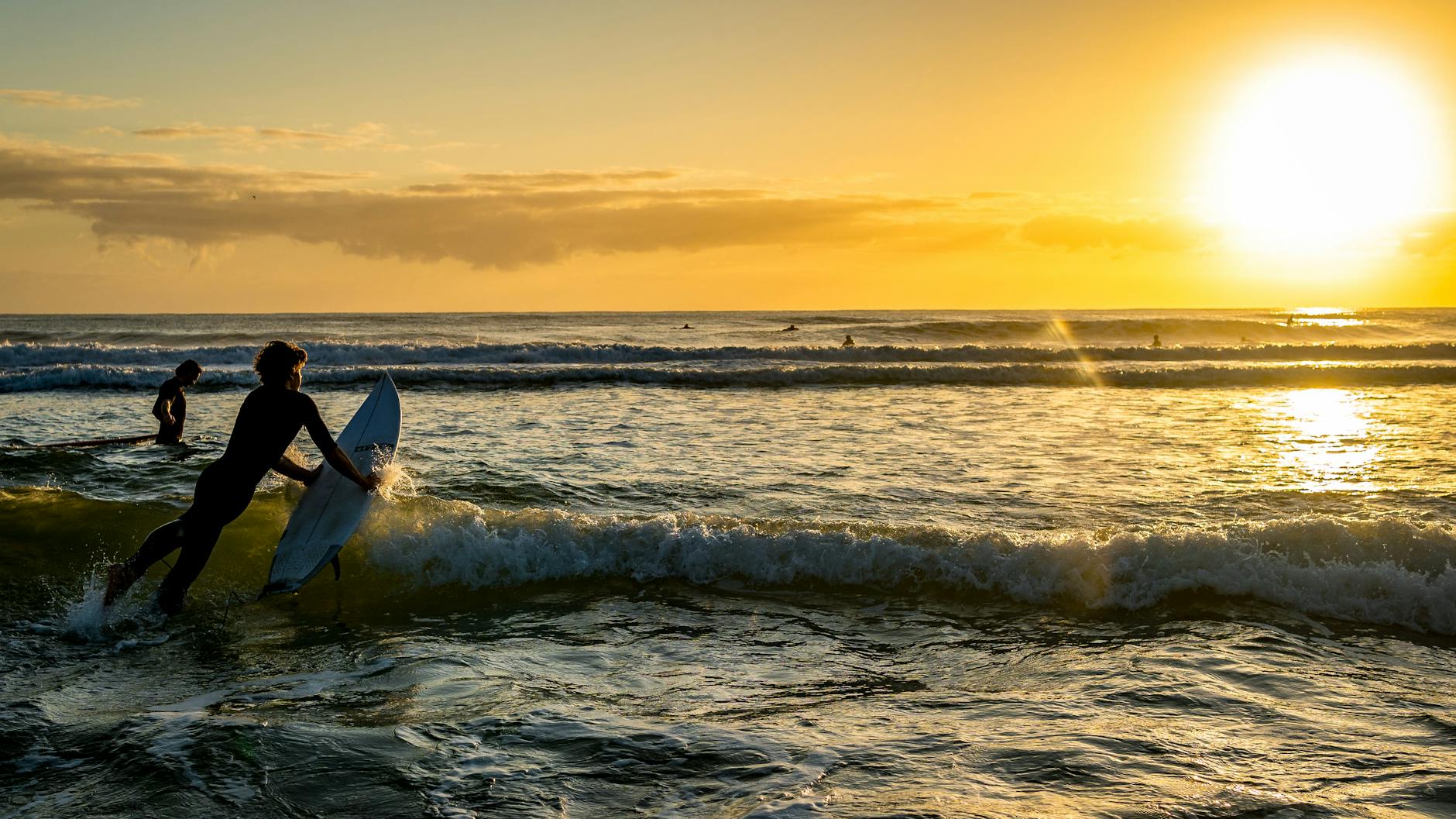
Kelly Slater once said: “Surfing is such an amazing concept. You’re taking on Nature with a little stick and saying, ‘I’m gonna ride you!’ And a lot of times Nature says, ‘No you’re not!’ and crashes you to the bottom.” Slater, who has won 11 World Surf League world titles, is also one of the sport’s most outspoken advocates for what practitioners describe as its spiritual dimension – the sensation of complete presence that a good wave demands.
This is not metaphor. It is neuroscience. And the data on why surfing produces altered states of consciousness rivals anything the meditation research literature has produced in the last decade.
The Science of Flow in the Ocean
Psychologist Mihaly Csikszentmihalyi defined flow as a state of complete absorption in a challenging activity where skill and challenge are precisely matched. His 1990 book Flow: The Psychology of Optimal Experience identified surfing as one of the clearest examples of a flow-producing activity. In flow, the prefrontal cortex – the seat of self-referential thinking, self-criticism, and rumination – partially deactivates in a process neuroscientist Arne Dietrich called “transient hypofrontality.” You literally cannot think about your mortgage while riding a wave at your limit.
A 2017 study by Lakey et al. in the Journal of Sport and Exercise Psychology found that surfers reported higher flow state frequency than athletes in any other individual sport studied, including climbing, skiing, and distance running. The reason is the environmental variability of waves – no two are identical, which means the challenge never becomes routine, and flow conditions are perpetually maintained as skill improves.
University of California San Diego researcher Michael Atkinson conducted qualitative interviews with 40 surfers and found consistent themes of ego dissolution, time distortion, and what subjects described as “merging” with the wave – phenomenological descriptions that match those from classic mystical literature (William James, Abraham Maslow, Abraham Heschel) on peak experience.
The Contrarian Take: Surfing is Not Automatically Spiritual
Here is what the books about surf culture rarely say: a large percentage of surfers are highly competitive, territorial, ego-driven, and experience almost no spiritual dimension in their practice whatsoever. Localism (intimidating non-locals out of breaks), dropping in, wax-over-wax aggression at crowded spots – these behaviours are common. The ocean does not automatically confer enlightenment.
What produces the spiritual dimension is not surfing per se but the combination of full-body presence, voluntary engagement with danger, and surrender to forces larger than oneself. You can surf for years without any of that if you stay in your comfort zone, ride only mellow beach breaks, and focus entirely on performance. The ocean will meet you wherever you are. It won’t push you toward depth unless you deliberately place yourself at your edge.
This is the practice: deliberately choosing waves that require your full attention. Deliberately paddling out when conditions are uncomfortable. Deliberately staying in the water when your mind is screaming to leave. Not reckless danger – calibrated challenge.
What Surfing Teaches About Presence
Eckhart Tolle’s The Power of Now describes presence as the cessation of mental time travel – the mind’s compulsive movement between past and future. He suggests it can be cultivated through practising stillness. Surfing teaches it through radical consequence: if your mind time-travels while you are paddling into an overhead set, the wave closes out over you and you get held down. The present moment is not a philosophical ideal in the ocean. It is a survival condition.
This is why experienced surfers often describe the water as their primary therapy. Not because it is relaxing – it frequently isn’t. But because it enforces the same quality of attention that meditation seeks to cultivate voluntarily.
What Surfing Teaches About Ego
The ocean has no interest in your self-image. It does not know your job title, your follower count, or how good you were last summer. Every session begins equal. Every wipeout is immediate feedback. The experienced surfer who paddles out at a new break and discovers the local current doesn’t care about their credentials has a choice: adapt or humbled exit.
Laird Hamilton, the big-wave pioneer who pioneered tow-in surfing at Teahupo’o and Jaws, has spoken in multiple interviews about ego dissolution in large surf: “When a 60-foot wave is coming at you, your ego is completely irrelevant. You either respond correctly or you don’t.” This is not spiritual language but it describes a precise mechanism: the self-concept is temporarily overridden by threat response, and in the space after survival – the paddle back out, the sitting on the board catching your breath – something quieter than ego remains.
What Surfing Teaches About Flow
Flow states have measurable neurochemistry. Research by Steven Kotler (Flow Research Collective) has identified a “flow cocktail” of neurochemicals released during the state: norepinephrine (focus), dopamine (reward prediction), anandamide (lateral thinking and pattern recognition), serotonin (well-being), and endorphins (pain suppression and social bonding). The combined effect produces what Kotler describes as the most productive and satisfying state the human brain can enter.
Surfing is one of only a handful of activities that triggers all five simultaneously. The physical demands activate norepinephrine. The reward of catching and riding a wave fires dopamine. The novel, ever-changing pattern of water releases anandamide – the “bliss molecule” also released by THC, which is partly why surfers often describe the feeling as stoned without any substance. The communal experience of a lineup triggers serotonin. The physical exertion produces endorphins.
Surf Traditions with Explicit Spiritual Dimensions
| Tradition | Origin | Practice |
|---|---|---|
| He’e nalu | Ancient Hawaii | Wave riding as communion with ocean deity Kanaloa; surfers would pray before entering water |
| Surfing as Zen | 1960s California | Santa Cruz and Malibu communities developed philosophical framework linking surf to Zen Buddhist non-attachment |
| Patagonia school | Yvon Chouinard era | Environmental ethics embedded in surf culture; the ocean as sacred space requiring protection |
| Soul surfing | 1970s counter-culture | Rejection of competition; surfing purely for intrinsic experience rather than performance |
| Dawn patrol practice | Universal | Pre-dawn sessions as meditative ritual; solitude, altered light, and calm conditions used deliberately |
How to Cultivate the Spiritual Dimension in Your Surfing
Three specific practices separate surfers who report flow and presence from those who treat it as sport only:
Pre-session sitting (5 minutes): Before entering the water, sit on the sand and observe the ocean for 5 minutes without moving. Watch the sets, the intervals, the direction. This is not strategic – it is attentional training. By the time you paddle out, your nervous system is already calibrated to the ocean’s rhythm rather than the pace of wherever you drove from.
Single-wave commitment: Select one wave per session that you would not normally paddle for. This is your edge. Paddling for it – regardless of outcome – produces more growth and more flow than riding 10 comfortable waves.
Post-session journaling (3 minutes): Not performance notes. Phenomenological notes. What did you notice? What thought appeared and what replaced it? When were you most completely in the present? This trains the metacognitive capacity to recognise flow states and make them more accessible over time.
For supplementary reading: Phil Jarratt’s Mr Sunset: The Jeff Hakman Story traces the development of spiritual dimensions in 1970s surf culture. Drew Kampion’s The Book of Waves treats the ocean as sacred text. Daniel Duane’s Caught Inside is the most honest account of a beginner confronting ego and ocean simultaneously.
Frequently Asked Questions
Do you have to be an advanced surfer to experience the spiritual dimension?
No. The spiritual dimension is available at every skill level because it emerges from the quality of attention you bring, not the difficulty of the waves you ride. Many beginner surfers report the most profound experiences on their first green wave – the novelty creates automatic full presence. The challenge for advanced surfers is maintaining that quality as skill makes conditions routine.
Can women’s surfing provide the same flow-state access as men’s?
Research on flow states does not show gender differences in access or depth. The limiting factor historically has been access to quality instruction and social permission to surf challenging conditions. That has changed substantially – the WSL CT women’s division now surfs identical conditions to the men, and female big-wave surfers like Paige Alms and Keala Kennelly are among the most accomplished practitioners of flow-edge surfing alive.
Is there a connection between surfing and psychedelic experiences?
Phenomenologically, yes. The anandamide release during flow produces states that overlap with low-dose psychedelic experiences – enhanced pattern recognition, ego softening, time distortion, and emotional openness. This is why the 1960s California surf culture intersected so directly with the psychedelic movement. Both were pursuing altered states; surfing produces them endogenously.
How is surfing different from other flow-state sports for spiritual development?
The ocean’s unpredictability is the key differentiator. Climbing, skiing, and cycling can all become routine at advanced levels – the challenge stabilises. Waves are never routine. This means the challenge-skill balance that produces flow is maintained indefinitely as skill grows. You also cannot control the ocean, which creates a structural confrontation with ego that indoor or controlled sports do not replicate.
Where are the best communities of spiritually-oriented surfers?
Byron Bay (Australia), Nosara (Costa Rica), Ericeira (Portugal), and Canggu (Bali) have large communities of surfers who consciously integrate yoga, meditation, and surf practice. The Surf Simply camp in Nosara explicitly uses flow state science as its coaching methodology. The Surfing Sangha – an informal Buddhist-influenced community – holds sessions at breaks in California, Hawaii, and New Zealand.
Related reading: Surfing and Spirituality: What the Ocean Teaches About Presence, Ego, and Flow
🌊 Join 10,000+ Ocean Lovers
Get our free Ocean Freedom Starter Guide + weekly guides on surfing, diving & nomad life.
No spam. Unsubscribe anytime.
🌊 Recommended Gear & Experiences
Some links are affiliate links — we earn a small commission at no extra cost to you.
As an Amazon Associate we earn from qualifying purchases.
We may earn a commission on bookings — at no extra cost to you.
🏄 DOWNLOADABLE GUIDE
Bali Surf Spots Map & Guide 2026
$9.99 — instant PDF download
Free for Ocean Lovers
Get the Ocean Freedom Starter Guide
Gear guides, destination picks, and honest advice for surfers, divers, and sailors. Free.
Join 500+ ocean lovers in our free community
Surf reports, dive trip planning, nomad tips — live in WhatsApp.