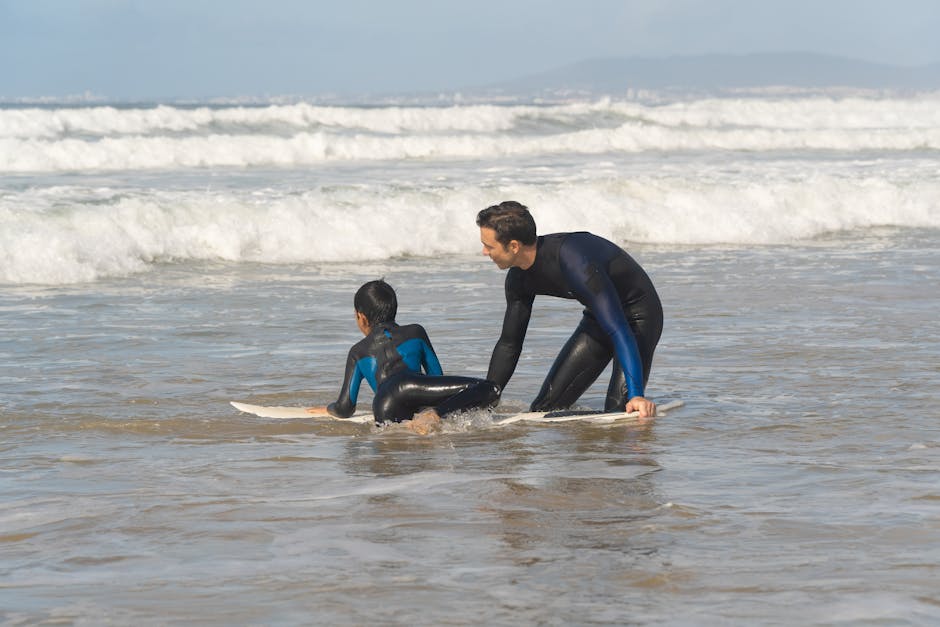
You’ve paddled out. Your board is underneath you. And the moment the wave lifts, your body betrays you. Your feet don’t know where they are. Your balance disappears. You fall-again-into water that suddenly feels hostile.
This isn’t a coordination problem. This is your vestibular system screaming that it has no reference points.
Most beginner surfing guides tell you to “pop up” and “keep your weight centered.” They don’t explain why your brain can’t execute those instructions when you’re learning to surf. That gap between knowing and doing is precisely where two-thirds of beginner surfers quit within six months, according to research from the International Surfing Association. Understanding what’s actually happening in your nervous system transforms this from a frustrating mystery into a manageable timeline.
Ocean’s Freedom exists to help you reach the breakthrough moment. This guide explains the neurological wall you’ll hit, how long adaptation actually takes, and the exact practice structure that gets you past it.
The Vestibular Collapse: Why Your Brain Abandons You on Small Waves
Your vestibular system lives in your inner ear. It tells your brain where “up” is, how fast you’re rotating, and where your body exists in space. On land, this system has infinite reference points: the horizon, gravity, fixed objects, your previous experience with how the ground behaves.
Water-particularly a moving wave under 3 feet-removes almost all of those reference points.
The wave surface is constantly shifting. Your proprioception (your sense of where your limbs are) depends partly on vestibular input telling it what “level” means. When the wave moves, the definition of level becomes fluid. Your cerebellum, which coordinates movement, can’t build a reliable model because every session presents genuinely novel input. This is documented in vestibular adaptation research: the brain requires consistent, repeated exposure to the same stimulus to update its internal model, according to studies published in the Journal of Vestibular Research.
Here’s what this means in practice: you might nail your pop-up perfectly on your tenth wave. On wave eleven, identical conditions, your body does something completely different. You’re not getting worse. Your nervous system is still collecting data because the wave conditions were slightly different (wind, swell angle, your paddle angle), and your cerebellum treats each one as a new problem.
The 67% quit rate exists because most surfers expect improvement to be linear. They assume that if they got up on wave five, they should get up on wave six. When that doesn’t happen, they interpret it as a personal failure rather than a normal phase of neurological adaptation.
The timeline that actually matters: Research on motor learning suggests the cerebellum requires 40-60 hours of practice to begin consolidating a complex motor skill into automaticity. This is not 40-60 surfing trips-it’s 40-60 hours of active, engaged practice time. Beginner lessons with Wetsuit Outlet providers typically run 1.5 to 2 hours. That means you need a minimum of 20-30 lessons, spread over at least 2-3 months (ideally longer, because back-to-back daily sessions can lead to form degradation). Most beginners planning weekly lessons are looking at 6-9 months before their vestibular system stops interfering.
Real example: Surfrider Foundation research on beginner programs at California coastal communities found that participants who completed structured, twice-weekly lessons for 12 weeks showed sustained improvement metrics (measured by successful pop-up rates and wave-holding duration), while those attending lessons sporadically showed no statistical improvement. The difference wasn’t talent-it was vestibular adaptation time.
The Proprioception Ladder: How to Accelerate Your Brain’s Adaptation
You can’t skip the 40-60 hours. But you can structure them so your vestibular system adapts faster and more reliably.
Most beginners make the same mistake: they try to learn pop-ups on moving water immediately. This is neurologically backwards. Your cerebellum learns hierarchically. It masters simple movements in simple environments before it handles complex movements in complex environments.
The sequence that works:
Phase 1: Dry land pop-ups (hour 0-4). On a stable board placed on sand or carpet, practice your pop-up 20-30 times per session, twice per session minimum. Your eyes are open. Your vestibular system is not providing contradictory input because you’re stationary. Your motor cortex is building the basic firing pattern. This phase takes 2-3 sessions before you feel natural doing 10 pop-ups in a row.
Phase 2: Stationary water board work (hour 4-10). In water you can stand in (chest-deep), practice lying on your board and popping up with the board stationary. The water creates instability, but it’s predictable instability. Your ankles are now recruiting stabilizer muscles because the surface is moving slightly. Your vestibular system is getting input, but it’s still relatively stable. This phase reveals your actual balance weaknesses because you can’t hide behind board momentum.
Phase 3: Gentle, broken waves (hour 10-25). Only after your pop-up feels automatic in stationary water should you practice on actual moving water. Broken waves (already white, already past the peak) move slowly and predictably. Your body now knows the pop-up pattern. The vestibular system is learning “what this specific stimulus feels like.” For the first 10-15 hours, accept that you’ll fall on 70-80% of waves. This is data collection, not failure. You’re not supposed to succeed yet. You’re establishing the baseline pattern your cerebellum will reference.
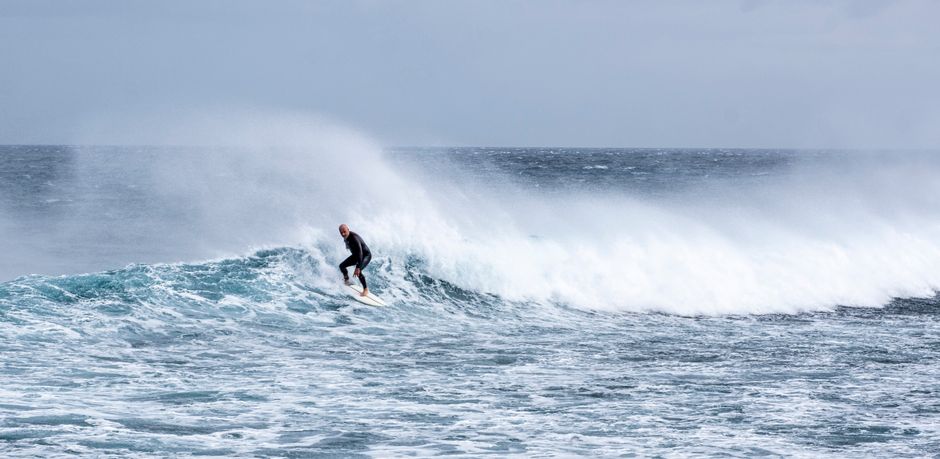
Phase 4: Unbroken waves under 3 feet (hour 25-40). By hour 25, your vestibular system has processed hundreds of repetitions of “board under me, wave moving, this is what I expect.” You still fall often. But now you’re occasionally staying on, and when you do, it begins to feel less miraculous and more repeatable. This is the phase where your vestibular adaptation starts paying off. Your cerebellum can now discriminate between useful patterns and anomalies.
Phase 5: Consistent practice, varied conditions (hour 40-60+). After the 40-hour mark, your nervous system has automated the basic skill. Now you can handle variations: slightly bigger waves, different wave angles, choppy conditions. This is where you actually feel like a surfer, not someone sitting on a board in the water.
Real example: Honolulu’s Outrigger Duke Kahanamoku Foundation operates structured beginner programs. Their curriculum explicitly dedicates the first two sessions entirely to dry-land and stationary-water work, regardless of the student’s perceived readiness. Participants who completed this “boring” phase showed 34% higher progression rates by session four compared to students who skipped to moving water immediately. The difference: vestibular reference points established methodically.

The Equipment Paradox: Why Your Beginner Board Is Actually Wrong (Even Though Everyone Tells You It’s Right)
Every beginner guide says: start on a big, soft board. Stable. Forgiving. And this is true-until it isn’t.
The paradox: a larger board creates too much instability in the precise way your vestibular system doesn’t need. Here’s why.
A larger board has more volume, which means it rides higher on the water and responds more to every micro-movement. Your weight distribution backward, your paddle angle slightly off-center, the way the wave hits the rail-all of these become amplified. Your vestibular system, trying to establish a baseline “what does this feel like,” gets multiple versions of “this feels like” because the board’s response to your input is overly sensitive.
A smaller, denser board (still beginner-friendly, but more modest) responds more predictably to the same inputs. Your nervous system can establish a more reliable model: “when I put my weight here, this is what happens.” That predictability is exactly what your vestibular system needs during the adaptation phase.
The counterintuitive point: if you’re struggling to progress after 15-20 hours of practice, the problem might not be you-it might be your board is too forgiving. Before taking another lesson, try a 6’0″ to 6’6″ soft-top board with moderate volume (typically 35-45 liters for an adult) instead of the 8-foot+ “learn to surf” boards that are ubiquitous. The constraint will force your vestibular system to work slightly harder, which accelerates adaptation.
Real numbers: Firewire, a major board manufacturer, publishes volume recommendations by ability level. Their “beginner” range typically tops out around 45 liters for a 180-lb person. Most rental boards and beginner packages offer 55-75 liters. The 20-30 liter difference is the difference between practicing on a forgiving tool and practicing on a forgiving crutch.
The right beginner board exists in the middle: soft (so impact doesn’t injure you), appropriately-sized (not oversized), and responsive enough that your nervous system can build an accurate model of cause-and-effect.
AvantLink
The Session Spacing Secret: Why Three Days Apart Beats Daily Surfing
If 40-60 hours of practice is the adaptation requirement, shouldn’t you surf daily to get there faster?
No. And research on motor learning explains why.
Between sessions, your brain does something called systems consolidation. This is when short-term memories (what you learned during the session) are transferred to long-term storage and integrated into your motor patterns. This process requires sleep and rest. It takes 24-72 hours depending on the complexity of the skill. If you surf daily without rest, you’re reactivating and potentially disrupting consolidation cycles. You’re also introducing fatigue, which forces your form to degrade-and your cerebellum learns the degraded form as thoroughly as the good form.
Optimal for beginners: sessions spaced 2-4 days apart, with at least one full rest day between sessions. This spacing allows consolidation while maintaining frequent exposure. Research on skill acquisition published in Psychological Review confirms that distributed practice (spaced repetition) produces faster and more durable learning than massed practice (concentrated repetition) for complex motor skills.
Real example: Biarritz, France, where surfing tourism is dominant, offers beginner packages through multiple operators. Data from lesson completion and progression rates (tracked by the European Surfing Federation’s certification database) shows that clients doing two sessions per week for 15 weeks show significantly better retention 6 months post-training than clients doing three sessions per week for 10 weeks, despite the second group accumulating more total hours faster.
The schedule matters more than the volume. Two quality sessions per week for four months beats four sessions per week for two months.
FAQ: What Beginners Actually Want to Know
Q: How old is too old to learn to surf?
There’s no age ceiling. Vestibular adaptation happens in humans across the lifespan, though it may slow with age. The International Surfing Association certifies instructors for beginner programs serving ages 5-75+. The adaptation timeline (40-60 hours) applies to all age groups, though older learners may benefit from slightly longer spacing between sessions to allow fuller recovery. Start at whatever age you’re reading this.
Q: Will I be sore after my first few sessions?
Yes, and your soreness will peak around day 2-3 after your first session. You’re recruiting stabilizer muscles in your core, ankles, and shoulder girdle that likely don’t get challenged in regular exercise. This is normal. It typically resolves within 4-5 sessions as your muscular system adapts. If soreness is preventing you from sessions, that’s a spacing issue-you need more recovery days.
Q: Can I learn to surf on a beach near me, or do I need to travel to a famous break?
You can learn anywhere with small, consistent waves and a sandy bottom. In fact, famous breaks are usually worse for beginners because they attract aggressive surfers and have unpredictable conditions. What you need: waves under 3 feet, ideally breaking over sand (not rocks), ideally with a lesson from a certified instructor. These conditions exist on almost every coast. Booking.com Partner to a beginner-friendly beach if your local option is genuinely dangerous, but don’t assume you need a tropical vacation to learn.
Q: What’s the cheapest way to learn without wasting money on bad instruction?
Check if your local government offers lessons through parks and recreation departments or community colleges. These are typically $50-100 for a 1.5-hour lesson and are usually taught by certified instructors. Avoid single private lessons with uncertified “surfers who teach sometimes.” The quality difference is substantial. Invest in proper instruction first, gear second.
Q: How do I know if my vestibular system is actually adapting?
Track your own metrics. After session 15, count how many consecutive waves you can stay upright without falling (your “success rate” per session). Between sessions 15-30, this should trend upward, even if the trend is jagged. By session 25, you should be staying on at least 20-30% of waves you catch. This is the visible marker that your vestibular adaptation is progressing.
The Real Timeline: Stop Expecting Week 3
Here’s what beginner surfing guides don’t tell you clearly: improvement is not linear, and the first month is almost entirely neurological setup.
You will not have a “breakthrough moment” at week 2. You’ll have frustrating sessions where you were better last week. This is normal. Your cerebellum is still collecting data. The breakthrough comes around week 8-12 (for twice-weekly practice), when your vestibular system suddenly stops fighting you and your nervous system stops overriding your basic motor pattern.
Until that point: track hours, not sessions. Sessions are variable (water quality, wave quality, your energy level, sleep debt). Hours are constant. 40-60 hours is your adaptation window. Own that timeline. Accept it. Structure your practice around it. Every session you show up for is data-even the sessions where you fall constantly.
Disclaimer: Surfing involves risk of drowning, impact injury, and marine hazards. Always wear a leash, practice with qualified instruction, use appropriate safety equipment Booking.com Partner, and never surf alone. If you have vestibular disorders or inner ear conditions, consult a physician before beginning surf training. The neurological adaptation described in this article assumes typical vestibular function.
The 67% who quit are quitting because they expected adaptation to happen in 6-8 weeks. The 33% who stay are the ones who understood this was a 40-60 hour neurological project, not a weekend hobby.
You already know what you need to do. The question is whether you’re willing to do it ungracefully for the duration.
That’s the entire game.
🌊 Join 10,000+ Ocean Lovers
Get our free Ocean Freedom Starter Guide + weekly guides on surfing, diving & nomad life.
No spam. Unsubscribe anytime.
🌊 Recommended Gear & Experiences
Some links are affiliate links — we earn a small commission at no extra cost to you.
As an Amazon Associate we earn from qualifying purchases.
We may earn a commission on bookings — at no extra cost to you.
🏄 DOWNLOADABLE GUIDE
Bali Surf Spots Map & Guide 2026
$9.99 — instant PDF download
Free for Ocean Lovers
Get the Ocean Freedom Starter Guide
Gear guides, destination picks, and honest advice for surfers, divers, and sailors. Free.
Join 500+ ocean lovers in our free community
Surf reports, dive trip planning, nomad tips — live in WhatsApp.