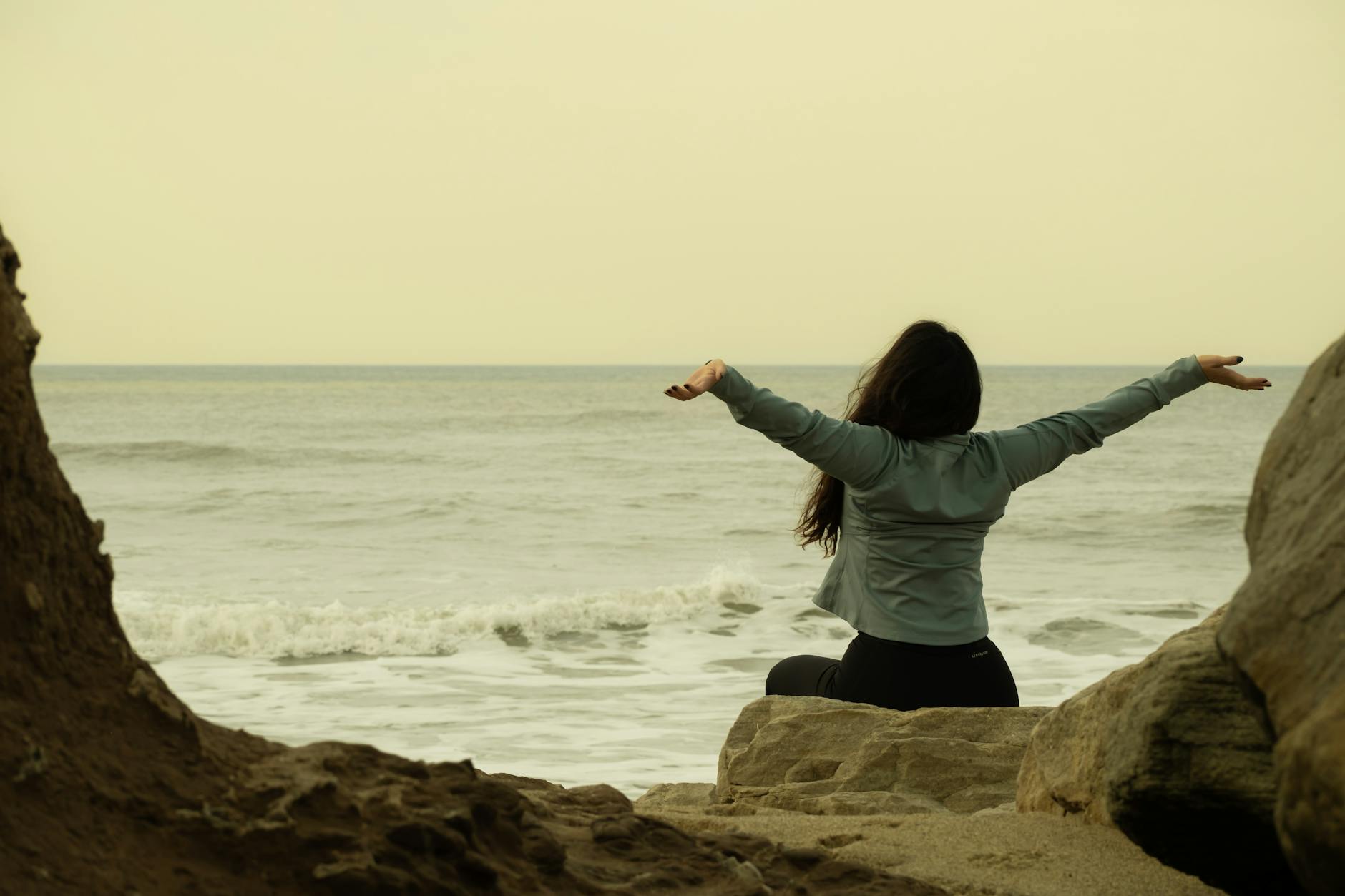
The ocean doesn’t care if you’re meditating correctly. It doesn’t track your streaks or send you a notification about your breathing. It just keeps generating this rhythm – waves arriving, building, collapsing, retreating – that your nervous system, evolved over millions of years in proximity to this sound, responds to in ways no app has ever replicated. Some people call it moving meditation. Others just call it sitting on the beach. The distinction doesn’t matter much.
This guide is for people who have tried meditation apps, found them hollow, and wondered why sitting in a bedroom staring at a wall never quite clicked. The ocean is a fundamentally different environment, and the science explains why.
Why the Ocean Works as a Meditation Space
Marine biologist Wallace J. Nichols, in his 2014 book Blue Mind, coined the term “blue mind” to describe the mildly meditative state triggered by proximity to water. His research, drawing on neuroscience, psychology, and ecology, found that coastal environments reliably lower cortisol levels, reduce rumination, and increase awe – three things that structured sitting meditation attempts to produce artificially.
A 2019 study published in Health and Place by White, Elliott, and colleagues analysed 26,000 participants in England and found that people living within 1 km of the coast reported 17% better mental health outcomes than those further inland. The effect was strongest at 0-500 m. The mechanisms include negative ion concentration (significantly higher near breaking waves), reduced visual complexity (a flat horizon versus cluttered cityscapes), consistent low-frequency sound from waves (shown to induce theta brainwave activity), and what researchers call “soft fascination” – effortless attention that doesn’t drain cognitive resources.
Theta brainwaves (4-8 Hz) are the same frequency range associated with deep meditation, light sleep, and creative insight. Standard mindfulness practice requires 20-40 minutes of focused effort to reach theta states. The ocean can trigger them within minutes of simply sitting and looking.
The Contrarian View: Why Apps Have Failed You
The meditation app market was worth $2.08 billion in 2023 (Grand View Research) and is projected to reach $6.5 billion by 2030. Apps like Headspace (25 million users), Calm (100 million downloads), and Waking Up dominate. They are useful tools. But they are also selling you an artificial substitute for something the natural world provides free of charge.
The majority of app-based meditators drop out within 30 days. One Calm internal cohort study found only 4% of users maintained a 30-day streak. The reason is not willpower. It is environment. A bedroom is a place of sleep, work, and distraction. The ocean is a place of biological deactivation. Your nervous system knows the difference even if your rational mind does not.
This is not an argument against apps. It is an argument for choosing your practice environment as carefully as you choose your technique.
Five Ocean Meditation Techniques (Ranked by Depth)
1. Horizon Gazing (Beginner – 5 minutes)
Sit facing the ocean with your eyes at horizon level. Soften your gaze so the horizon becomes slightly blurred. Breathe naturally. When your attention moves to a boat, a wave, a bird, gently return it to the horizon. No counting. No mantras. This practice activates the parasympathetic nervous system almost immediately through its horizon-level sightline – a posture your nervous system associates with safety (no predator can approach unseen on a flat horizon).
2. Wave Breath Synchronisation (Beginner – 10 minutes)
Inhale as a wave builds. Exhale as it breaks and retreats. Natural ocean waves arrive at 8-14 second intervals – which maps almost exactly to the 5.5-breath-per-minute rate that cardiologist Stephen Porges (Polyvagal Theory) identifies as the coherence frequency for heart-rate variability. You are essentially doing resonance breathing without counting, guided by the sea itself.
3. Cold Water Immersion Meditation (Intermediate – 15 minutes)
Enter the ocean up to your chest. Stand still. The initial shock triggers a controlled sympathetic response (norepinephrine spike of up to 300% has been measured in cold immersion studies by the University of Groningen). After 2-3 minutes, as the cold receptors adapt, the body shifts into a deeply calm parasympathetic state. This is the physiological basis of the Wim Hof Method’s ocean protocol. Water temperature of 15-18°C is ideal for this practice; below 10°C requires gradual cold training first.
4. Walking Tide Meditation (Intermediate – 20 minutes)
Walk barefoot at the water’s edge, matching your footfall to your breath. Left foot: inhale. Right foot: exhale. The tactile variability of wet sand, shells, and receding water creates what psychologists call “grounding” – a term that also has a literal electrochemical meaning: direct skin contact with the earth’s surface has been shown to reduce inflammatory markers and improve sleep latency in studies published in the Journal of Environmental and Public Health (Chevalier et al., 2012).
5. Floating Meditation (Advanced – open-ended)
Float on your back in calm water. Close your eyes. Arms out, legs apart. This is the most complete sensory reduction possible without a float tank – and it is free. The challenge is ego dissolution: when visual and auditory stimuli are reduced and proprioception is disrupted (the ocean holds you without effort), the internal critic quiets remarkably fast. Advanced practitioners report states indistinguishable from deep meditation within 10 minutes. Begin in calm, warm water (above 24°C) and never float alone until you are comfortable with the vulnerability of it.
Best Ocean Meditation Locations Worldwide
| Location | Why it works | Best time | Water temp |
|---|---|---|---|
| Byron Bay, Australia | North-facing beach, calm mornings, community of practitioners | May-October | 22-26°C |
| Amed, Bali | Protected bay, glassy at dawn, zero crowds before 7 a.m. | April-October | 27-29°C |
| Comporta, Portugal | Wild Atlantic coast, dunes for seated practice, low tourism | June-September | 18-22°C |
| Tulum, Mexico | Caribbean clarity, cenotes for immersion practice nearby | November-April | 26-28°C |
| Essaouira, Morocco | Constant trade wind (white noise effect), wide beach, low humidity | May-September | 18-22°C |
Building a Daily Ocean Meditation Practice
The research on habit formation (James Clear, BJ Fogg) consistently shows that time and location specificity are the two most powerful predictors of practice consistency. “I meditate at the ocean” is weaker than “I meditate at Bondi Beach, North End, facing south, at 6:15 a.m., before coffee.” The specificity creates an automatic contextual trigger.
For those without daily beach access: replicate the sensory cues. A 12-inch desktop zen garden with fine white sand. Ocean soundscapes (search “real ocean ambience” on YouTube – avoid synthesised versions; your nervous system can tell the difference). A cold-water face immersion (sink or bowl) activates the mammalian dive reflex even without full immersion, lowering heart rate within 30 seconds.
For retreat-level immersion: Blue Mind Retreats (Koh Samui, Thailand; from $1,800 for 7 days), Surfari Wellness (Lisbon to Algarve, Portugal; from $1,400 for 5 days), and the O.C.E.A.N. programme at Rancho La Puerta in Mexico ($3,200 per week) all offer structured ocean meditation within professional facilitation. For solo travel, the combination of a freediving foundation course ($280-380 in Amed) with self-directed morning meditation practice is arguably more transformative than any resort programme.
Recommended Reading and Tools
Wallace J. Nichols’ Blue Mind remains the foundational text – the Audible narrated version is worth it for driving coastal roads. For the somatic side of ocean practice, Bessel van der Kolk’s The Body Keeps the Score explains why physical environments matter more than cognitive techniques for nervous system regulation. If you want to combine meditation with freediving, Umberto Pelizzari’s Manual of Freediving contains a chapter on mental training protocols used by competitive apnea athletes that maps directly to meditation technique.
Frequently Asked Questions
Do I need prior meditation experience to start ocean meditation?
No. Ocean meditation is in many ways easier than indoor practice because the environment does most of the work. Beginners report success from day one with simple horizon gazing. If you have tried and failed with apps, you will likely find the ocean approach more natural.
Is it safe to meditate alone at the ocean?
Seated practice on the shore is safe. Cold water immersion and floating should never be done alone. If you plan to enter the water as part of your practice, go with a buddy or within visual range of a lifeguard. Shallow water blackout risk from breath-holding is real even in experienced practitioners.
How long should a session be?
Research on minimum effective dose suggests 12 minutes of focused practice produces measurable changes in cortisol. For ocean-specific practice, 20 minutes at the shore at dawn or dusk (when light is softer and crowds are absent) produces the most reliable results. Duration matters less than consistency – 15 minutes daily beats 90 minutes weekly.
What about cold water – do I have to enter?
No. Seated shore practice is the most accessible and produces real measurable effects. Cold immersion amplifies outcomes but is not required. Start where you are comfortable.
Which meditation traditions include ocean-based practice?
Several. Tibetan Buddhist rigpa practice uses open-sky and open-water gazing as pointing instructions for recognising the nature of mind. Japanese Shinto practice includes misogi, purification via cold water immersion. Indigenous Australian traditions use ocean country as the primary ceremonial space. You do not need to belong to any tradition – the ocean is open source.
Related reading: Ocean Meditation: How to Use the Sea as Your Practice Space
🌊 Join 10,000+ Ocean Lovers
Get our free Ocean Freedom Starter Guide + weekly guides on surfing, diving & nomad life.
No spam. Unsubscribe anytime.
🌊 Recommended Gear & Experiences
Some links are affiliate links — we earn a small commission at no extra cost to you.
As an Amazon Associate we earn from qualifying purchases.
We may earn a commission on bookings — at no extra cost to you.
🧘 DOWNLOADABLE GUIDE
Yoga Retreat Packing List — Complete Guide
$5.99 — instant PDF download
Free for Ocean Lovers
Get the Ocean Freedom Starter Guide
Gear guides, destination picks, and honest advice for surfers, divers, and sailors. Free.
Join 500+ ocean lovers in our free community
Surf reports, dive trip planning, nomad tips — live in WhatsApp.