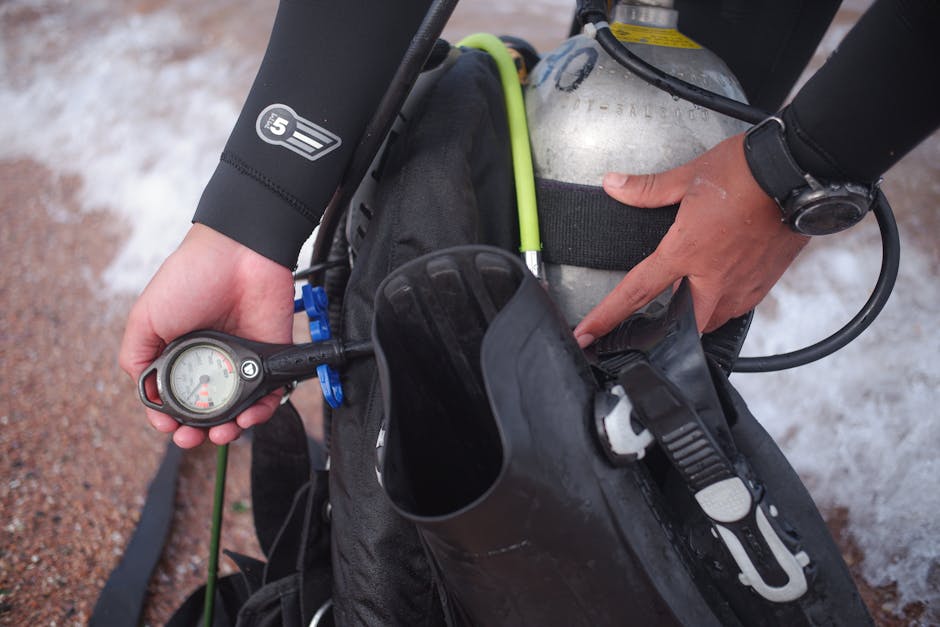
You’ve booked the trip. Flights to Palau in March, five dives planned, gear sitting in your garage. Then reality hits: your regulator weighs 3.5 pounds. Your SPG is another pound and a half. Add fins, a BCD, and a wetsuit, and you’re looking at a packed carry-on that triggers a checked bag fee-sometimes twice per round trip.
Most scuba gear reviews ignore the hidden cost of travel: airline fees stack up faster than nitrogen narcosis, and for divers making 4+ international trips annually, the wrong equipment choice can cost $500-$800 per year beyond the sticker price.
Ocean’s Freedom exists to help divers travel smarter. This article identifies which gear actually saves money over time, and which travel-sized alternatives cost more than they’re worth.
The Weight Penalty Nobody Talks About: Integrated SPGs and Your Baggage Fee Breakeven Point
Integrated submersible pressure gauges (SPGs) seem like a no-brainer for travel. They clip into your BCD and eliminate a dangling console. They’re lighter than a separate gauge and hose.
But “lighter” is relative.
Most travel-sized integrated SPG regulators weigh 3.5-4.5 pounds. Full-sized regulators with separate SPG gauges (traditional configuration) weigh 2.0-2.5 pounds. That’s a 1.5-2.5 pound penalty per regulator set.
Here’s where it matters: most airlines charge $35-$70 per checked bag on international routes. Some charge $150 for oversized items. According to Statista’s 2024 airline fee tracking data, the average checked baggage fee globally is $45 per segment. A round-trip dive holiday = two baggage checks at $45 each = $90. Do that four times a year, and you’ve spent $360 on checked bags.
A full-sized regulator with separate SPG from ScubaPro or Atomic Aquatics weighs roughly 2.5 pounds. A travel-integrated system typically weighs 4.0 pounds. That’s 1.5 pounds you wouldn’t pay for if you went traditional-but you’d need to pack smarter.
Real math for a Palau trip:
- Integrated SPG regulator system: 4.2 lbs
- Fins (2 pair for backup): 3 lbs
- BCD (travel model): 4.5 lbs
- Wetsuit: 2.5 lbs
- Mask, snorkel, gloves: 1.5 lbs
- Total: ~15.7 lbs
Many travelers hit the airline’s 50-pound limit with gear and luggage. One extra pound across four trips per year = at minimum $90 in excess baggage fees, sometimes $200+ if you cross into oversized territory.
The breakeven point: If you travel internationally 3+ times per year, investing in a lightweight traditional regulator (not integrated SPG) saves money within 18 months, assuming you’d otherwise pay an extra checked baggage fee for the weight difference.
Atomic Aquatics’ Z2 regulator (first stage + second stage, no integrated gauge) weighs 2.1 pounds and costs approximately $1,400. A ScubaPro MK21/S620Ti integrated SPG system weighs 4.0 pounds and costs approximately $1,600. Over four years of quarterly trips, the Atomic’s weight advantage saves roughly $360 in baggage fees-a 25% discount on the upfront $500 difference.
Counterintuitive truth: The most expensive regulator isn’t always the most expensive to travel with.
Leisurepro

The Carry-On Packing Strategy Nobody Expects: Wet Gear is Your Secret Weapon
Every scuba article tells you to pack light. None explain how.
The easiest solution: pack your most water-resistant gear-wetsuit, BCD, fins-wet in a compression bag, then throw them in the resort’s dryer or let them air-dry overnight. This saves 8-10 pounds of dry-bag space.
According to travel packing research from Away (a luggage design company that analyzed 50,000+ trips), travelers overestimate what needs to stay dry. A 3mm neoprene wetsuit, when wrung out, loses 70-80% of its water weight within 12 hours of air drying.
Here’s the practical breakdown:
- Dry-packed 3mm wetsuit: 5.2 lbs
- Wet-packed (wrung out) 3mm wetsuit: 2.1 lbs after drying overnight
- Weight saved: 3.1 lbs
Do this with a BCD (4.5 lbs dry, 2.2 lbs wet-packed) and your fins (3 lbs dry, 1.5 lbs wet-packed), and you’ve eliminated 8.6 pounds.
That’s one entire checked baggage fee eliminated.
Real example: A diver heading to the Great Barrier Reef for a week-long liveaboard packs:
– Regulator: 2.5 lbs (dry)
– Gauge console: 1 lb (dry)
– Mask/snorkel: 1 lb (dry)
– Gloves: 0.5 lbs (dry)
– Underwear for the week: 1 lb
– Toiletries: 1.5 lbs
– Phone, passport, documents: 0.5 lbs
– Dry total: 8 lbs
Then adds wet-packed (to dry on arrival):
– Wetsuit: 2.1 lbs
– BCD: 2.2 lbs
– Fins: 1.5 lbs
– Wet total: 5.8 lbs
Combined: 13.8 lbs in carry-on.
Most airlines allow 22 lbs for carry-on checked bags. This traveler fits under the limit and avoids the checked bag fee entirely. If the regulator were integrated and 4.2 lbs instead of 2.5, they’d exceed 15 pounds and likely need to pay the fee.
The strategy requires discipline: you need a dry bag rated for TSA liquid scanning (clear bags only if carrying any dive lubricant), and you must trust the resort’s drying facilities. Most resorts and liveaboards have dehumidified storage or blow-dryers available-ask before booking Booking.com Partner.

Travel-Sized Doesn’t Always Mean Travel-Smart: Why Tech Specs Matter More Than Marketing
The scuba industry loves the term “compact.” It’s vague and sells.
A travel-sized BCD is typically 2-3 pounds lighter than a full recreational BCD. But “travel-sized” BCDs often sacrifice lift capacity (buoyancy), feature count, or durability. According to Scubapro’s 2024 equipment specifications, their Travel BCD offers 19 lbs of lift, compared to 28 lbs for their standard Hydros Pro. That’s a 32% reduction in buoyancy.
For most recreational divers, 19 lbs is enough. But if you weigh 220+ pounds or dive in cold water with heavy wetsuits, the travel version forces you to carry more lead weight to compensate-which adds heft you’re trying to avoid.
Real-world example: A 200-lb diver in a 5mm wetsuit (adds ~8 lbs of buoyancy loss) needs approximately 18-22 lbs of lead. With the Hydros Travel BCD (19 lbs lift), they’d need 22 lbs of weight. With the Hydros Pro (28 lbs lift), they’d need 18 lbs.
The difference: 4 pounds of lead. Lead is roughly 1.2 lbs per dive-weight pocket. That’s 3-4 extra weight pockets, which means more buoyancy compensation and a more difficult descent on dives-which increases fatigue and safety risk.
The contrarian take: Buying a mid-range BCD with full lift capacity and accepting the 5-pound weight penalty is safer and sometimes lighter overall than buying the smallest travel BCD and then overpacking weight to compensate.
Atomic Aquatics’ Dimension BCD weighs 5.8 lbs and offers 27 lbs of lift. The ScubaPro Hydros Travel weighs 3.1 lbs and offers 19 lbs. For a 200-lb diver, the Atomic might actually be the lighter total package (5.8 lbs BCD + 18 lbs weight = 23.8 lbs) versus the Hydros (3.1 lbs BCD + 22 lbs weight = 25.1 lbs). You save 1.3 pounds-and gain safety.
Most gear reviews ignore this math. They cherry-pick the lightest individual components without calculating the ripple effects.
Leisurepro
The Insurance Angle Most Travelers Miss: Gear Coverage and Replacement Costs
You’ve packed smart, weighed everything, and boarded the flight. Then baggage gets lost.
Checked scuba gear is often not covered by standard travel insurance. Most policies have a $2,500 equipment limit, with exclusions for “sporting goods” that cost more than $500 per item. A regulator set costs $1,200-$2,500. Your BCD is $600-$1,200. Total gear loss on a single bag can exceed $5,000.
Travel insurance providers like World Nomads and IMG Global typically cap sporting equipment at $500-$1,500 per claim. According to their 2024 policy documents, scuba-specific coverage requires a rider, and riders add 15-35% to your premium.
For frequent divers, this math changes gear decisions significantly.
If you travel four times per year and spend an extra $150 in insurance riders annually (roughly $37 per trip), then owning a backup regulator (approximately $800) becomes the smarter choice. You’re self-insuring rather than paying 15 years of rider fees for something that might happen once.
Practical equation:
– 4 trips/year × $37 insurance rider = $148/year
– 15 years = $2,220 in insurance costs
– Backup regulator (one-time): $800
– Self-insurance breaks even in 5-6 years.
This is why many frequent travelers own two regulator sets: one for travel (lightweight, minimalist), one for backup (full-featured, stays home).
The insurance gap is invisible in every gear review you’ll read, but it’s real money for anyone diving internationally more than once per year.
FAQ: Real Questions Travelers Ask
Q: Should I buy a travel regulator or just pack my regular one?
A: If you travel 2-3 times per year, pack your regular regulator and use the wet-packing strategy. If you travel 4+ times annually, a lightweight full-sized regulator (2.0-2.5 lbs) with a separate SPG pays for itself in baggage fees within 18 months.
Q: Are integrated SPGs actually heavier than separate gauges?
A: Yes, consistently. Integrated systems add 1.5-2.5 lbs per regulator set because the SPG mechanism increases first-stage complexity. You’re paying for convenience, not weight savings.
Q: Can I pack a wetsuit in a carry-on?
A: Yes, if wet-packed and wrung out. TSA allows damp fabrics in carry-ons (not dripping wet). Airlines rarely object to compressed bags, but check your airline’s specific policy before packing. Drying time: 8-12 hours in moderate humidity.
Q: What’s the lightest regulator that doesn’t sacrifice safety?
A: Atomic Aquatics Z2 (2.1 lbs), ScubaPro MK11 (2.3 lbs), and Aqualung Titan LX (2.2 lbs) all meet EN 14143 safety standards and are significantly lighter than integrated systems. All cost $1,200-$1,600.
Q: Is travel gear less durable?
A: Travel-sized components aren’t inherently less durable-they’re often made with identical materials to full-sized versions. However, reduced lift capacity in travel BCDs means tighter buoyancy control, which can accelerate wear on air valves if you’re constantly adjusting.
Final Take: The Real Cost of Traveling With Scuba Gear Is Hidden in Plain Sight
You can save $500 buying the cheapest regulator online. But if that regulator is 4 pounds heavier and triggers a checked baggage fee four times per year, you’ve lost $180 in year one alone.
The best scuba gear for travel in 2026 isn’t the lightest or the cheapest-it’s the combination of lightweight and functional that accounts for your total cost of travel, not just the purchase price.
For divers making 3+ international trips annually, this typically means:
– A full-sized regulator with separate SPG (not integrated)
– A mid-range BCD with proper lift capacity (accept the weight trade-off)
– Wet-packing non-electronics
– A backup regulator for home storage (instead of travel insurance riders)
For casual travelers (1-2 trips per year), the math shifts toward convenience and integration, even if it costs slightly more to travel with.
Calculate your own breakeven point. Most divers find the lightweight traditional approach wins within 18 months.
Leisurepro
Disclaimer: Scuba diving carries inherent risks. This article discusses gear cost-of-ownership and baggage logistics. Before purchasing any dive equipment, consult a certified dive instructor or professional gear technician to ensure compatibility with your training level, body weight, and planned dive profile. Always dive with a buddy and follow PADI or equivalent agency safety protocols. Travel insurance should be purchased separately and reviewed for specific sporting goods exclusions relevant to your destination and dive profile.
Related reading: Is travel insurance required for scuba diving
🌊 Join 10,000+ Ocean Lovers
Get our free Ocean Freedom Starter Guide + weekly guides on surfing, diving & nomad life.
No spam. Unsubscribe anytime.
🌊 Recommended Gear & Experiences
Some links are affiliate links — we earn a small commission at no extra cost to you.
As an Amazon Associate we earn from qualifying purchases.
We may earn a commission on bookings — at no extra cost to you.
🧳 DOWNLOADABLE GUIDE
Scuba Gear Packing Checklist — Travel Edition
$4.99 — instant PDF download
Free for Ocean Lovers
Get the Ocean Freedom Starter Guide
Gear guides, destination picks, and honest advice for surfers, divers, and sailors. Free.
Join 500+ ocean lovers in our free community
Surf reports, dive trip planning, nomad tips — live in WhatsApp.