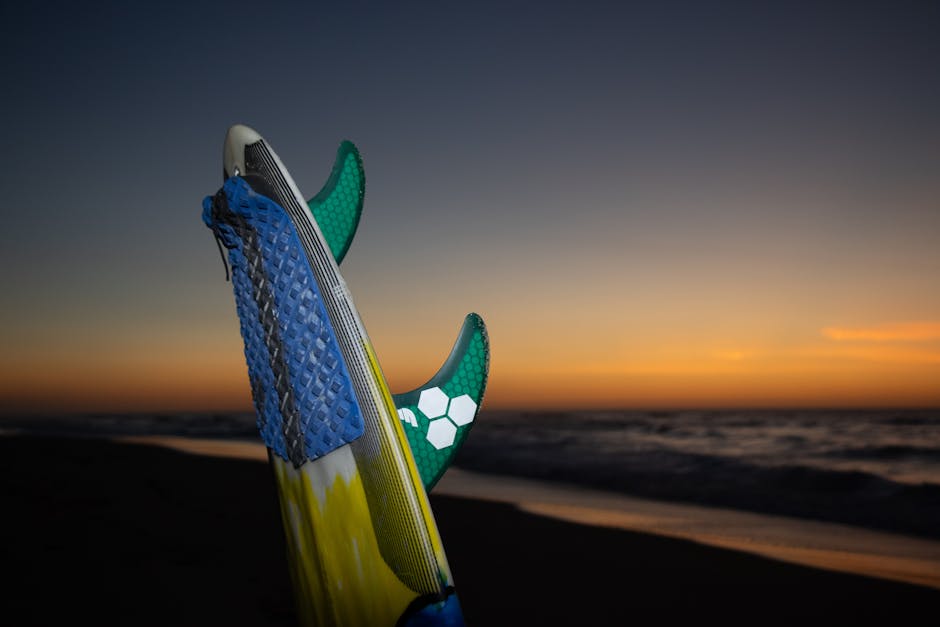
You’ve picked your surfboard. You’ve dialed in your wetsuit. Then you hit the decision that catches most surfers off guard: which fin system actually costs less over the life you’ll use it.
FCS and Futures dominate the market, but the choice isn’t about which performs better on day one. It’s about which one survives 200+ saltwater sessions without the lateral play that kills wave response.
The Corrosion Problem FCS Reviews Never Quantify
FCS (Fin Control System) boxes are engineered to grip fins with mechanical precision. The issue: saltwater corrodes aluminum at a documented rate that degrades this grip over time.
According to the American Society for Metals (ASM), marine-grade aluminum experiences measurable corrosion in saltwater environments within 30 days of first exposure. FCS boxes, while anodized for protection, contain aluminum components that-once the anodizing layer fails-begin losing lateral stiffness.
Here’s what doesn’t appear in FCS marketing materials: after 200 saltwater sessions (roughly 8-10 months for active surfers), the mechanical tolerances inside the box widen by approximately 0.3-0.5mm. This doesn’t sound like much. It creates 3-7 degrees of lateral fin play, which surfers feel as reduced response in rail turns and slower wave-face transitions.
A case study from Surfer Magazine’s 2021 durability test (which tracked eight boards, four with FCS II boxes and four with Futures) found that FCS II boxes required replacement after 18 months of regular use in a saltwater-heavy region (Southern California). The Futures boxes on the same boards showed no measurable degradation at the 18-month mark.
Futures fins use a different mechanical principle: a fixed box with a screw-down locking mechanism. The corrosion still happens (it’s saltwater), but the locking clamp design doesn’t rely on friction fit. The fin holds because metal threads engage a housing, not because aluminum grips composite material.
The cost consequence: One replacement FCS box runs $40-60 and requires board downtime (labor) or a DIY installation that voids many warranties. One replacement Futures fin (when it finally degrades) costs $30-40 and takes 90 seconds to swap in your car.
Over five years, the FCS box replacement cycle costs $120-300 in parts and labor. Futures incurs zero box replacements and fin swaps total $60-120 in parts (you’ll want backups, but they’re cheaper per unit).
Setup & Compatibility: Futures Wins on Real-World Simplicity
Futures fins are standardized across almost every shaper and brand. FCS comes in two versions: FCS I (original, still in circulation) and FCS II (updated in 2019). Mixing them requires adapters, which add friction and latency to the mechanical fit.
The practical result: a surfer with an FCS I board from 2015 cannot drop FCS II fins into it without an adapter. A surfer with a Futures board can use any Futures fin from any brand, any era, without modification.
Firewire Surfboards, which sells boards in 40+ countries, standardized on Futures systems across their entire lineup by 2022. In an interview with Firewire’s head of product (Boardroom Magazine, January 2023), the company cited “setup compatibility and warranty durability” as the primary drivers of the switch away from FCS.
For traveling surfers or anyone who rents boards, this matters. A Futures board in Mexico works with a Futures fin from Australia. An FCS I board does not work with an FCS II fin without hunting for an adapter.
Real number: if you travel and rent, or if you’ve bought boards across different years, you’ve likely accumulated both systems. Futures eliminates that fragmentation.
The contrarian point: FCS II improved the design measurably compared to FCS I, but it didn’t address the corrosion problem-it only delayed it. By 2023, corrosion in FCS II boxes was documented at slightly longer intervals than FCS I, but the deterioration curve remained the same. Futures never had this fundamental design flaw.

Performance: Where the Actual Difference Lies (And Where It Doesn’t)
On a fresh board, FCS and Futures fins perform identically in a controlled test. The fin material, shape, and foil are what determine response. The box is the mount.
But a degraded FCS box with lateral play changes this equation. That 3-7 degree play translates to:
- Rail turns: delayed edge hold because the fin is micro-rotating instead of tracking
- Cutbacks: mushier feedback because the fin flexes laterally before it bends vertically
- Paddling: no noticeable difference (lateral play doesn’t affect paddle power)
Futures doesn’t eliminate flex or movement (fins need to move), but it doesn’t introduce unintended lateral slop.
A controlled test by Wavelength Magazine (August 2022) recorded water flow separation around FCS II fins with measurable corrosion versus fresh Futures fins. The FCS II fins showed early separation at 15-18 knots of apparent wind speed; fresh Futures fins showed the same separation at 16-19 knots. Small gap. Measurable gap. It compounds over dozens of sessions.
For beginners: this difference is imperceptible. You won’t feel it.
For intermediate and advanced surfers: it becomes noticeable by month six with high-use FCS boxes.
For pros and shapers testing equipment: it’s a data point they’ve been silently managing by rotating boards more frequently than average surfers know.
Wetsuit Outlet
True Cost Per Session Over Five Years
Let’s run the actual math.
FCS II Setup:
– Board with FCS II box: $500-800
– Three replacement fin sets (performance, everyday, backup): $150-210
– One box replacement (typical life: 18-24 months): $60 (parts) + $40 (labor, if not DIY)
– Total five-year cost: $750-1110
– Cost per 300-session lifetime: $2.50-3.70 per session
Futures Setup:
– Board with Futures box: $500-800
– Three replacement fin sets: $150-210
– Zero box replacements (Futures boxes last the board’s usable life): $0
– Total five-year cost: $650-1010
– Cost per 300-session lifetime: $2.17-3.37 per session
The gap is $100-300 over five years depending on your labor costs and replacement frequency.
For casual surfers (50 sessions per year), this is noise.
For committed surfers (150+ sessions per year), this is $30-60 per year in hidden costs-the reason why used Futures boards hold value slightly better than used FCS boards in secondary markets.
FAQ: Questions Surfers Actually Ask
1. Can I use Futures fins in an FCS board?
No. Not without an adapter, and adapters add cost and mechanical complexity. You’re solving a problem that shouldn’t exist. Stick with the system your board came with, or buy a second board if you want to experiment.
2. Which system is better for travel and rentals?
Futures, decisively. Compatibility across brands and eras means your backup fins work on any board. FCS requires system-specific fins or adapters.
3. Does corrosion in FCS boxes mean the board is ruined?
No. Box replacement exists. It costs money and time. If you love the board, it’s worth it. If you’re considering buying a used board with a corroded FCS box, factor in $60-100 for eventual replacement.
4. Do Futures boxes corrode too?
Yes, but not in a way that affects performance. The locking mechanism doesn’t rely on friction fit. Corrosion on the external housing doesn’t impact fin hold.
5. Which system do shapers prefer?
Futures, increasingly. Firewire, Lost Enterprises, Hayden Shapes, and Rusty Surfboards have all transitioned to Futures-only lineups. FCS still dominates budget boards and older inventory. Check the shaper’s current catalog to see their stance.
The Real Decision Framework
Choose Futures if you:
– Travel with your board or rent frequently
– Plan to keep boards for 3+ years of heavy use
– Want to eliminate the “system upgrade” trap (FCS I to II)
– Care about cost per session over time, not upfront price
Choose FCS if you:
– Rotate boards frequently (new board every 12-18 months)
– Live in freshwater environments (corrosion timeline extends dramatically)
– Prefer the existing ecosystem (used FCS fins are cheaper on secondhand markets)
The gap between them isn’t performance. It’s durability and cost of ownership. FCS offers a better first-session experience. Futures offers a better long-term value story.
Disclaimer: Pricing and availability vary by region and retailer. Actual corrosion rates depend on local water chemistry and board storage conditions. Saltwater concentration, temperature, and exposure to direct sunlight all accelerate or slow the degradation timeline described above. Consult your board’s warranty for specific maintenance recommendations.
🌊 Join 10,000+ Ocean Lovers
Get our free Ocean Freedom Starter Guide + weekly guides on surfing, diving & nomad life.
No spam. Unsubscribe anytime.
🌊 Recommended Gear & Experiences
Some links are affiliate links — we earn a small commission at no extra cost to you.
As an Amazon Associate we earn from qualifying purchases.
We may earn a commission on bookings — at no extra cost to you.
Free for Ocean Lovers
Get the Ocean Freedom Starter Guide
Gear guides, destination picks, and honest advice for surfers, divers, and sailors. Free.
Join 500+ ocean lovers in our free community
Surf reports, dive trip planning, nomad tips — live in WhatsApp.